SHIRVAN NATIONAL PARK
9 927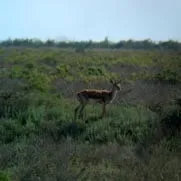
A two-day seminar organised by the American journalists' organisation ICFJ for environmental journalists from the countries of the South Caucasus was held the other day. The first seminar took place in Baku, and identical seminars are to be held later in Tbilisi and Yerevan. The seminar is devoted to the biological diversity of the Caucasus region and its proper coverage in the media of the three countries. A seminar is also planned in the future for the countries of the North Caucasus, since it is precisely on the territory of the Greater and Lesser Caucasus ranges that the greatest species diversity of animals and birds in all of Europe is found.
The organisers and participants of the seminar were pleased to note that over the last 5-6 years our country in particular has paid great attention to the development of protected areas and has created new national parks, of which Azerbaijan now has seven. Naturally, much attention was paid to the biodiversity of Azerbaijan, which must be preserved for future generations. The seminar also "voiced" the idea that it is not possible to study and protect the flora and fauna on the currently occupied territory of Azerbaijan. Nevertheless, the Ministry of Ecology and Natural Resources of Azerbaijan, together with other state bodies, is doing everything it can to get work going in the protected areas of our blessed country.
Shirvan National Park, which is today one of the best protected areas in Azerbaijan, was chosen as the meeting place for the environmental journalists. And so, early in the morning, we all set off together from Baku to visit Shirvan National Park...
A COUNTRY'S NATURAL WEALTH IS ITS NATIONAL HERITAGE
At the gates of Shirvan National Park we were met by its director, a German citizen (working in our country specifically in the field of creating national parks), Mr. Hartmut Müller. He has been working on the territory entrusted to him since 29 January 2007, i.e. a little over a year. And in this short time he has managed to bring some positive changes to the protection of the national park.
First of all, I would like to say a few words about Shirvan National Park itself, which was created in July 2003 on the basis of the Shirvan State Reserve. It is located on the territory of three districts of Azerbaijan: Qaradağ, Salyan and Neftçala. The purpose of creating this protected site is to preserve the unique semi-desert landscapes and the goitered gazelles listed in the Red Book of Azerbaijan, as well as other species of flora and fauna of this unique zone...
Surprising as it is, it is a fact that a large part of the Shirvan steppes was once the bed of the Caspian Sea. And although today it is merely a plain, traces of ancient settlements can still be found here - Bəndovan and Muğan, which were located in the Gushtasfi area (left over from the early Middle Ages). To this day, historical monuments survive on the territory of the National Park in the form of all kinds of burials from various eras and peoples who lived in the Shirvan steppe.
It lies in the zone of moderately warm semi-deserts and dry steppes. Summers here are hot and dry, winters are mild. Several types of vegetation are found in the reserve: desert, semi-desert and meadow. And the animal world presents a diversity you won't find anywhere else. Among them are rare and endangered species: the steppe cat and jungle cat, goitered gazelle, badger, Syrian spadefoot, green toad, tree frog, marsh frog, Caspian and Mediterranean tortoises, blunt-nosed viper, Montpellier snake, black francolin, white-tailed eagle, steppe eagle, peregrine falcon, saker falcon and many other species. Wolves, foxes, jackals and wild boar are not uncommon here. And they all coexist as best they can: they hunt, escape from predators, court females, raise offspring - regardless of the fact that there are people nearby protecting them...
Two years ago, the Development Plan of Shirvan National Park for 2006-2009 was adopted. It provides for five areas: protection of the territory, tourism development, research monitoring, administrative work. The priority issues in this plan are protection measures and the development of ecotourism, so as not only to preserve the natural resources of Shirvan, but also to create a material base for the further development and improvement of the National Park.
According to the price list approved by the Ministry of Ecology and Natural Resources of Azerbaijan, our citizens can explore the ecological routes for two manats, and foreigners for four.
All tourists are met at the gates and helped to choose one of five tourist routes. On the territory of the National Park there is a special information centre where you can get any information you are interested in about the park, as well as a small conference hall where various meetings are held, for example, one like ours.
Once all the paperwork is done, a special guide sets off by bus with the tourists along the route they have chosen. In a few hours, tourists can see the volcanoes, the largest of which is the Bəndovan mud volcano, which according to scientists is 23 million years old, and the volcanoes at Girovdağ, as well as other natural and historical monuments of the park, visit Chigil Island and see the flora and fauna of these places with their own eyes.
WHEN ECONOMY MEETS ECOLOGY...
Speaking of Shirvan National Park, one cannot fail to mention another remarkable fact: it is the only protected area in Azerbaijan where oil is extracted. Although, under the rule generally accepted all over the world, any economic activity is prohibited in protected areas, oil was and still is extracted in our National Park (and before that in the Shirvan Nature Reserve). A fact which, by the way, environmental specialists consider a flagrant violation. However, according to Mr. H. Müller, oil is not extracted on the territory of the National Park itself; the small plot of land where oil is produced cuts into the park's territory but is not part of the protected area.
"Oil has been extracted here since 1962, while the first protected area in this locality (back then it was still a wildlife sanctuary) was created in 1961. Today up to 19 thousand barrels a year are produced from several wells. That is a considerable benefit to the state treasury, provided, of course, that it does no damage to the environment and biodiversity. Today oil production on this site does not bother us, since the oil company "Salyanoil", which carries out the oil development, has undertaken to clean up a large area once polluted with oil. But you know yourselves that oil production in Soviet times did great damage to nature, yet back then nobody thought about the consequences... Besides, gas is produced on the Bandovan peninsula. But believe me, this does not hinder the development and growth of the populations of animals protected in the National Park. The greatest damage to us was done by local residents who grazed their livestock on the park's territory, thereby depriving the goitered gazelles of their forage base".
By the way, we saw very few gazelles during the whole trip, although it is known that there are now more than 4000 of them on the territory of Shirvan National Park.
"The gazelles are now in their breeding season. The females have separated from the males, they are carrying and giving birth to their young, so until the end of May you won't be able to see large herds of gazelles", - Mr. Müller commented on this situation.
It is also known that Shirvan National Park lies on the migration route of migratory birds, and this is a very important factor, since rare and globally endangered bird species often winter in our protected area, for example the little bustard, the smallest member of the bustard family. In winter one can observe a flock of 50 thousand little bustards here, which in itself is a great rarity... By the way, the park's bird kingdom is represented by 230 species. The National Park's current goal is to be included in the list of wetlands of international importance, i.e. those protected by the Ramsar Convention.
In addition, work is under way to improve the existing tourist routes and develop infrastructure in order to attract more visitors. Foreign scientists who conduct research on the bird life often come here. There are good conditions for the work of foreign naturalists; it is possible to provide them with all the necessary transport, tents for long-term stays...
With the support of the Ministry of Ecology and Natural Resources of Azerbaijan, several task forces were set up, for example for bird flu, fires and so on. Shirvan National Park currently employs 55 staff: researchers, guards (rangers), and a guide who accompanies tourists. True, the salaries of the staff (and of the National Park's director, too) leave much to be desired. But the income received from National Park visitors goes to its own needs, for example buying computers, technical equipment and so on.
According to H. Müller, last year Shirvan National Park was visited by more than 700 tourists. "It's a pity that they are mostly tourists from other countries. I am a foreigner, but I know Azerbaijan's nature better than many of your citizens. For some reason your people don't know, or don't want to know, what riches they possess. Several times I approached the executive authority of the nearby district (Salyan) with a proposal that children and young people from different schools of the district be brought here every month to get acquainted with the biodiversity and other attractions of the park. But to this day the promotion of Azerbaijan's natural heritage here remains very weak. I don't know what the reason is, but the fact itself worries me, since it is precisely the young generation that should know what we want to leave them as a legacy"...
PROTECTION FIRST AND FOREMOST
Having driven across the entire territory of Shirvan National Park, we noted to ourselves a rather significant fact: on this huge territory of 65000 hectares there was no GARBAGE! Truly German tidiness. "I myself never allow myself to throw garbage anywhere other than a specially designated place, and I demand neatness from my employees. People come here to rest, to enjoy the silence of pristine nature, and their eye should not "stop" on piles of garbage or plastic bottles. All the more so since over 60% of visitors are foreigners. Shirvan National Park is not only a protected area — it is the face of the nation. I want them, when leaving your country, not to think badly of you..."
To our question of what awaits a person who wants to kill a goitered gazelle and eat a kebab made from its meat, Mr. Muller stated quite specifically that it would cost a fine of 9000 manats and several years of "free vacation" behind bars! Quite an impressive explanation, isn't it, one that requires no further clarification.
The territory of Shirvan National Park is now fenced, but not along the entire perimeter. And the management decided that the remaining part also needs to be "shielded" from unwanted encroachment. "We were offered the idea of creating a kind of "underground corridor" for the gazelles so that they could migrate through it to other places, but I did not agree, since poachers could use this corridor, and that is not at all desirable for us".
And finally, we would like to put it in the words of Mr. Muller: "Shirvan National Park is the national heritage of Azerbaijan. And it is not I, a foreigner, who should take care of it. It is the business of every citizen of Azerbaijan! You must try to preserve it for future generations...".
P.S. (from the editor-in-chief). This is very much like the behavioral type of Azerbaijanis: our own National Park is visited by foreigners, and order there is also kept by those same foreigners, as if they need it more than we do — the residents of this country. It's exactly the same with democracy in Azerbaijan. Everyone tries to make us live as in normal, highly civilized countries, by the way for our own good, and we call it "interference in internal affairs". In short, it's time to start valuing life in order to learn to live well. And it all begins with love for our lesser brethren.
Comments (0)
Registered members will be able to comment once registration opens.