Long-distance casting - a "master class" by Terry Edmonds, part 1
24 447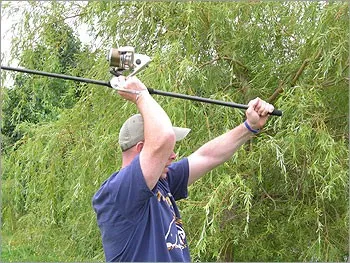
I'd like to tell you a little about myself. I learned my casting skills at casting tournaments, competing against some of the best casters in the world, and I spent many hours learning what gives you confidence when making a cast. As a result, I've won many club competitions against international casters, set a ground record and achieved a personal best of over 270 yards (~ 246 metres). For about 20 years I've fished for carp on and off. This brief background shows that I know how a cast is done.
How do I increase my casting distance? Mostly I get asked about the overhead cast, because this casting method is rightly used by almost all carp anglers, since it gives high accuracy and, when done correctly, can be quite powerful.
To make the longest possible cast, you have to make the lead travel through the biggest possible arc within the limits of each specific style during the cast; big arc = high lead speed = distance, so this is the most important aspect of the cast that we need to achieve, and with the overhead cast it is, luckily, easy to achieve.
Photo 1 shows what I call the typical cast of carp anglers, which I see all the time, not only during coaching but on the bank too. This cast can be very accurate, but it's not very good for long distances. If you look at the right arm, it's bent so that the reel is almost touching the head, the left arm is also bent up to eye level, and I'm looking at the water, which is very good for accuracy but useless for distance. This has to change!!!! Combine this technique with a powerful long-range cast and try as hard as you can to bend the rod. If you don't bend it, it won't work for you.
Now take a look at photo 2 - here everything is set to really send the lead a very long way. The straightened right arm is above the head, creating a pivot point, a big arc and also a big lever.
The left arm is also straight and generates all the speed and power. The right arm actually does practically nothing during the cast. All the power and acceleration during the cast come from pulling the left arm down very fast, which, when done correctly, creates speed and arc and also lets you use the rod effectively - most carp rods are easy to bend.
At first it will feel a bit strange, but spend 30 minutes casting the way described above and I practically guarantee a significant increase in your casting distance.
The next step is using your body weight - in any throwing activity, weight is used effectively. I've very rarely seen anglers using their body weight effectively when making long casts (stopping at the water's edge and almost falling into the lake - I'm cracking up). All you have to do to use your body weight is take up your normal casting position, but shift all your weight onto your back foot - lifting the toe of your front foot will make it easier. When you feel like you're almost falling backwards, you've done it right. See photo 3.
Now the lead hangs MOTIONLESS under the rod. I'm always amazed at the number of anglers who swing the lead. I can't see any obvious reason for it and I don't understand why they do it!!! We don't need any swinging of the lead at all, since it can affect the direction and consistency of the cast.
So, your body weight is shifted back and your arms are raised high, now let's move on to the cast itself.
1. A big slow step forward.
2. Lean forward in the direction of the cast.
3. Now sharply pull your left arm down to your chest.
Using the step and your body weight before the cast lets you preload the rod tip, which makes the main cast much more skilful. This happens because if the tip is loaded in advance, during the short power stroke of the cast it no longer needs to be loaded, and all the power of the cast is transferred to the butt faster. The rod will be much easier to bend, and as a result it's used much more effectively. See photos 4 and 5.
Fine-tuning the drop when castingThe drop is one of the most important elements of any cast and can be fine-tuned individually to get the best feel for the cast, since it affects the consistency of the cast, its height and the feel of the rod.
To make this easier, I'll give you a rule of thumb - usually the drop should never be below the joint of the rod sections, but that's a good starting point. If the rod feels soft, gradually shorten the drop inch by inch until it feels right, but with an overhead cast never make the drop shorter than to the first ring from the rod joint.
After each change of the drop, the consistency of the cast and the feel of the rod will change too. Once the cast feels comfortable, stop changing the drop and put a mark on the rod blank. From then on, this will let you make every cast from the same starting position of the lead.
Practice makes perfectI've practised casting for hundreds of hours (usually preparing for tournaments or testing rods). As with everything involving body movement, practising consistency and technique makes perfect. I guarantee that by following the advice in this article you'll be able to keep improving your cast endlessly, and you'll find it much easier to reach spots you used to barely reach with everything you had.
My top tips for getting those precious extra yards1. Remember these pointers before you raise your arms up:
look up and forward, step slowly, and when your front foot
is planted on the ground, cast!!!!!
2. All the power and speed come from the left hand, the right hand is just the pivot (and the other way round if you're left-handed).
3. The line drop is very important.
4. Use sinkers weighing 3.5 to 4 ounces (as a rule).
I hope this little article has been of help to you. I tried to keep it as simple as possible. Next time we'll talk about tackle that can help with the cast, but first get the technique right, because you may be surprised at how far your current abilities can take you.
It is very important to study this section before attempting a long-distance castPlease use a shock leader. I recommend either 65 lb Berkley Whiplash or a Fox tapered leader - both are excellent products.
A leather finger stall is another must-have item. You can buy one quite cheaply at a pharmacy. And it's much better to have a finger stall than a nearly severed finger. Trust me on this, I've seen serious cuts from braided shock leaders slicing into fingers.
Making sure the drag is fully tightened is another sure way to avoid losing a finger after a powerful cast.
I want to mention one more thing you should pay attention to - what is around you and who/what is in the danger zone when you cast. Passers-by, natural objects and other anglers can end up "in the line of fire", so please be careful.
I'm always happy to help or teach, so drop me an email
Good luck and good casting.
Comments (0)
Registered members will be able to comment once registration opens.