DAGESTAN.One of the highest peaks in the world, Mount Shalbuzdag — conquer it and you can hope your most cherished wish will come true .
It was August 24! There is a belief among people that climbing Erenlar seven times
is equal to making the pilgrimage to Mecca – the Hajj. This mistaken belief should be
dispelled right away. It is not so! No matter how many
times you climb. According to Muslim theologians (alims),
a pilgrimage or ziyarat to the graves of people counted among the saints
(awliya) on Erenlar is a deed pleasing to God. This summer our family and I climbed once again, for the second time now, to "Pir Erenlar", which is on Shalbuzdag in southern Dagestan.
The climb up Shalbuzdag is a very interesting procession in itself. On top of that, on the day of our climb there was a "mawlid" organized by the people of Miskindzha. This added even more color, since there were more people (pilgrims) than usual, and they came from all corners of Dagestan, Azerbaijan and Russia. It was surprising to see a small group of Georgians among the pilgrims too. These Georgians weren't necessarily Muslims, but one of the pilgrims not from that group said that these places are revered not only by Muslims, but by Christians and Jews as well.
We drove from Qusar, across the border; the crossing took us about 1.5 hours because of long checks and all the other border fuss. Another 1.5 hours later we were already in Miskindzha, where at the entrance to the village there were UAZs ("Willys" and "bukhankas") with green flags and lots of people crowded around. Because of the large number of pilgrims there weren't enough cars. Anyone who has been here knows that the way to Erenlar goes through the village of Miskindzha, along a road snaking up the mountain. Finally our turn for a car came. We got into a UAZ, the "Willys" type. With us in the car were an endocrinologist from Makhachkala and a married couple from Gaptsakh. And so we started our "run" up the mountain. I was surprised by the number of people and cars on the mountain road, going up and coming down. And the Miskindzha guys who provide the shuttle service (by the way, a one-way trip costs 500 rubles) sometimes manage to race each other right there on the mountain road. Our driver, Mezahir, turned out to be no slouch either. A good, tough driver can manage three runs a day, which, as they explained, is very exhausting, but impressive. Because it had poured with rain the night before, some stretches of the road were washed out. And halfway up there were already stuck trucks with passengers in the back. The stuck vehicles blocked the way for everyone else coming behind. So a column of 20-25 cars formed. Everyone got out of the cars and started helping to pull out the stuck trucks. Meanwhile, for some reason I clearly remember the moment when one of the Miskindzha drivers told off the driver of a red "Lada 110" who had turned on music on his car stereo. It was instructive: a pilgrimage isn't quite tourism (and judging by the mood of the red "Lada 110" driver, that's exactly how it looked to him), and certain rules of conduct and behavior should be followed.
After half an hour of battling the mud, the trucks finally got moving. We drove on. Since the road isn't wide enough for two cars to pass each other freely, we often had to stop at special mini-pullouts to let cars coming down with pilgrims already heading back go by. After a while we were there. The road from Miskindzha to the parking lot next to the Suleyman mosque took 1.5-2 hours.
As soon as we got out of our "UAZ", two pigeons flew up to us and landed very close by on a rock next to where we had stopped. The symbolic arrival of the pigeons reinforced the established belief that the body of the late Suleyman was carried here by pigeons. A joking thought flashed through my mind that these pigeons were greeting the arriving pilgrims this way and expecting a treat from them - sadaqa.
I should note that the mosque has been done up and nicely finished compared to what it was like in 2001, during our first ziyarat here. Here at the mosque you're supposed to perform certain rituals typical of such places, such as: giving out your sadaqa, going into the mosque, praying, then walking around it seven times (although according to Muslim theologians such circling is wrong), making dua and so on. Within half an hour there was no room left in my bag to collect all the sadaqa. I, in turn, didn't end up losing out either.
After the rituals at the mosque you're supposed to go further. Which we did. Go on foot, that is, since there's no road for vehicles beyond this point. From here to the next stop the way is short. The low lamp posts along the path gave a pleasant sense of how carefully this place has been looked after.
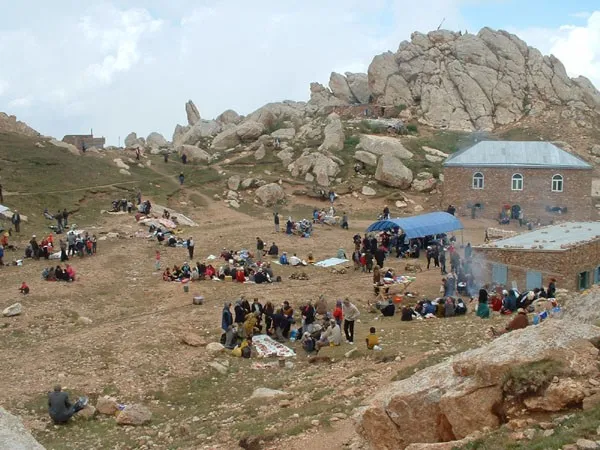
The next stop is where most of the pilgrims gather, the pass. This place looks like a hollow among the rocks. The altitude is already pretty high. Probably 2500-2700 meters. There's a mosque here too, a two-story one, and a couple more little houses where people pray, sleep and rest. Sacrifices are also made here. You don't have to bring the sacrificial lamb up the mountain with you, since you can buy one right on the spot. Judging by the number of sheepskins, many sacrifices had been made that day. Mawlid! The Miskindzha women were cooking food for the pilgrims in big cauldrons. You could go up and get anything from plov to meat stew. All of it charity.
Having so many people from different corners around you can't help but make you want to talk. We were amused by the reaction of a young Dargin guy – a short, good-natured "Dargin, brother" in reply to my younger brother's question in Lezgin. Still, we managed to find a common language and get an answer to our question. Meanwhile, our attention was caught by a dignified, white-bearded aksakal in a big sheepskin papakha, who looked like a naib from the days of the Caucasian War. After watching his mentor-like gestures and conversations for a while, eating some sadaqa and generally getting to know the camp, we settled down on a small rock and struck up a conversation with our neighbours. Anyone could see with the naked eye that most of those arriving and leaving were female pilgrims. A peculiar kind of emancipation, I suppose.
So the people there chat with each other, pray, sing religious chants, stroll around, eat and so on. Overall the atmosphere is very healthy and friendly.
And it only gets better! After a rest, a taste of the sacrificial meat and prayers, you have to keep going up, to the peak. The well-trodden trail to the peak is "swarming" with people going up and coming down. As usually happens, those going up keep asking the happy ones coming down: "Is there much left?".
The way to the peak is very interesting and absorbing. All around there are only bare cliffs of red and grey stone. The views are majestic. The people coming down greeted us quite warmly, saying "May Allah accept your ziyarat". Chatting on the go with the descending pilgrims lets you work out the geography of who's there – Akhty, Derbent, Magaramkent, Belidzhi, Kaspiysk, Makhachkala, Khasavyurt, Kizlyar.Baku.Moscow. Interesting was the "wow"-type reaction of a young Tabasaran woman who was "actually, not from Dagestan" but from Ashgabat, to my "I'm from Baku". Apparently the sunny warmth of the two cities doesn't leave a person indifferent. An elderly, short man from Akhty with funny, nimble movements and playful eyes reminded me of a "baby in old age". Having paid due respect to the aksakal and taken a photo together, we move on.
Along the way you could eat candies and other wrapped sweets left here and there by pilgrims as sadaqa. The mountain path is tiring, so a snack doesn't hurt. On the steeper stretches there were wooden walking sticks lying around, which you're supposed to leave right there after using them for support to get over those steep stretches.
The rocky trail leads to a small pool called Zamzam (after the name of the holy water in Mecca) with very clear and very cold water. They say this water has healing properties. A respectable Lak woman with the "revolutionary" name Oktyabrina, who later came down with us, said she would take this water to a laboratory in Makhachkala, since she'd heard that if you dilute a glass of this water with a bucket of ordinary water, the water in the bucket takes on the same properties. It's worth noting that the water level in this pool never changes. Having drunk this water and filled 2 bottles, we continue on our way again.
Right after Zamzam you mustn't miss the chance to throw stones at the shaitan. Or rather, it's mandatory for the ziyarat to be complete. In the cliff, not very high up, there's a hole 60-70 centimetres in diameter. You have to hit it with a stone so that the stone stays in there. Then you turn around and throw a pebble into another, much smaller hole in the opposite cliff. You should see how hard the pilgrims try. It brings to mind footage of the stoning of the shaitan in Mecca, where throwers often manage to hit each other. In our case, luckily, everyone gathered managed to hit the target without injuring those standing nearby. Anyway, with the shaitan stoned, the path continues. Not much left. Now comes a slightly harder task – you need to climb up and squeeze through a rock fissure about 2.5 metres high, or whatever you call it – a crevice. That doesn't mean the path actually runs through this fissure. You can skip it, go around it so to speak. But in that case the pilgrimage will be considered incomplete. The idea is that if a person isn't pure of soul, the rock will squeeze them and they won't be able to get up. Thank Allah, I managed it on the very first try.
After this test, a little further on, you find yourself at the very spot that pilgrims call the peak. The way here from the previous stop took 4.5 hours. All around there are still red-grey cliffs, but they no longer crowd in on us so tightly. Everywhere there are small structures built of flat stones, resembling bunkers. People go in there, make dua, pray to Allah, leave things, various sweets and so on. A girl may, for example, leave her headscarf and take another one, as one of our fellow travellers did. There are various piles and structures of stones that you have to crawl under and squeeze through, and at the very end climb up a rock crevice, the very last and most important one. Having successfully passed this test too and recited dua, all that was left for us was to admire the beauty and majesty of the surrounding cliffs.
Being here at the peak and looking around, you see a very funny sight – people, like chipmunks, climbing out and squeezing through from under the rocks all over the place. A whole system of rock crevices and holes to get through one after another makes you feel like you're taking part in a Zarnitsa war game. When these procedures were over, we listened to the azan and zikr performed by four Lezgins. The echo of the azan off the rocks, coming out of the fog, created a special feeling. Having thanked them for the azan and the mesmerizing zikr, we set off on the way back. On the way back you can fill the containers you brought with Zamzam water, which is what everyone did.It really is a holy mountain,because even after fishing or going mushroom picking my legs usually ache,but here it was 4142 metres up into the mountains and nothing,I was fine!!!
So, having made our ziyarat to Erenlar and the climb to the summit of Shalbuzdag, having handed out our sadaqa and fulfilled our niyyah, we headed back to Miskinja, and from there on to the village of Kuysun.
For me the climb up Shalbuzdag meant twice as much, because in the space of just two weeks I managed to climb two of the most revered peaks of my people - Shalbuzdag and Shahdag.
May Allah accept your ziyarat!Comments (13)
Скажу как художник ,художнику - написано СУПЕР!Allah Gabul Eləsin Zijarətvi.Отличное путешествие.
Потрясающе написано!! Очень завораживает
тебе надо писателем стать
salam alekum!!!! ya uvajayu vas i vsex podvodnix bratyev no vseje ya skaju svoye mneniye Suphan Allah kakoy biydat vi sovershayete i vse te kotoriye tuda xodat Allah hidayat versin siza!!! vse shto vi napesali vse eto bolshoy grex yest tolko 3 mesto dla polomnichestva eto Mekka Madina(mechet) i Al-Aksa(3-svatina musulman)v Ierusalime a ostalniye mesta schitat za polomnichestvo nelza gardash!!! vi napesali В«Пусть Аллах примет ваш зияратВ». Allah nikogda takoye ne primet v etom vi mojete bit uvereni i yeshe bilo skazano peli pesni voobshe v islame pesni zapresheni!!! yesli ya ne oshibayus v toy mecheti gde krujat tam na xoditsa mogila! vo pervix nelza sovershat namaz tam gde mogili!! krome janaza namazi vo vrema poxoron!!!a pobivaniya shaytana eto vooshe nechto gde gde v dagestane!a nazvaniye vodi zam-zam sperevoda s arabskogo eto glagol zama oznachayusheye svazivat ne razbegatsa mat izmaila pitalas sobrat vodu!! etot istochnik bil otkrin arxangelom!!! i on naxoditsa v Mekke v predelax
mecheti al-Xaram i bolshe nigde ne mojet naxoditsa ya soglasen voda chistaya xoroshaya no ne svetaya!!! takshto ya vam mogu pojelat shtob Allah vam vsem i mne v tom chisle hidayat versin!!! mi greshim daje ne osoznavaya shto eto odin iz samix bolshix grexov ........ s uvajeniyem Emin
mecheti al-Xaram i bolshe nigde ne mojet naxoditsa ya soglasen voda chistaya xoroshaya no ne svetaya!!! takshto ya vam mogu pojelat shtob Allah vam vsem i mne v tom chisle hidayat versin!!! mi greshim daje ne osoznavaya shto eto odin iz samix bolshix grexov ........ s uvajeniyem Emin
Alekuma salam!!!vobweto ya ne as v etom dele,imeyu v vidu riligiyu,ya napisal towto est towto sliwal ot mestnix i ne mestnix lydey(50 % iz nix bili iz Azerbaydjana)est daje film dokumentalniy pro etu goru(shalbuz dag) i pro pir Suleymana kotoriy tam naxoditsa.ti mena konewno izveni esli ya obidel teba svoim ot4otom,ya pisal towto est!a kakje Bew barmag,i drugie svetie mesta,lydi ved toje tuda xodat!po tvoim slovam oni vse grewniki?davay ne budem rastegivat etot razgovor pro religiyu potomuwto eto ve4niye spori i nedoponimaniye.day ALLAH tebe zdorovya!!!
Мое мнение такое,что если человек поднялся на эту гору и вернулся назад,значить что БОГ уже был с ним,это Gabul,и дал возможность сделать это,А если это было не Богоугодное дело,как бы Poladik не старался он бы и шагу не сделал.А слово Zijarət обозначает ,,посетить" какое либо место,не обезательно святое.С большим уважением ко всем,внезависимости от вероисповедания.
Aga ya poderjivayu vawe mneniye!!!posle moevo poxoda tuda moi jelanie potixonku ispolnayutsa,tfu tfu ne zglazit)))
salam alekum!!! net gardash ti mena ne obidel nichut svoim otchetom!!! mesta super bazara net a na schet pirlara eto vse napredumano dla kollosalnogo biznesa(5 barmagin istoriyu yesli uznayete sosmexu podeti ya dosexpor nemogu ponat prichem zdes pir schego oni vzali!! eto prosto naxoditsa na ochen udachnoy doroge BAKU-Rastov denushki rekoy v kormanchiki popadayet ) v islame etogo net eto so storoni irana prishlo a razgovor konechno etot vechniy i nikto nikomu nedokajet ya svoy dolg vipolnil pered Allahom preduprediv vas a dalshe vam vidno ))) pishite otcheti pobolshe shtob bilo shto chitat ato zdes gde ya mojno suma soyti s etimi kitaycami. pochemu nepishut pocani otcheti shto nikto na oxotu nexodit? day allah vam vsem zdorovya
ALLAH u4tёt eto,spasibo brat !!!
http://sharvili.com/index.php/content/view/123/2/ ай-ай-ай.... как не стыдно poladik, заниматься плагиатом... Эта статья была написана еще в 2005 году. Теперь народ даже может поставить под сомнение ваш личный поход в это место. Можно было бы просто дать ссылку на источник и смело выставлять сам контент. Нарушение авторских прав так сказать. http://sharvili.com/index.php/content/view/123/2/
Expose-ni4ego tut stidnovo net,kogda ya evo 4ital etot raskaz sxodstva bili porazitelniye vot i ne stal zanovo vso eto so4inat,i esli ti evo 4ital to tut i ot seba ya koe wto dobavil 4ego net tam,polu4ilos daje interesneye!a esli narod somnevaetsa wto ya tam bil pust smotrit fotki s moim li4nim prisustviem,a kto ne verit, mne kak-to vso ravno,SAMOE GLAVNOE YA TAM BIL !!!a tebe poxodu zanatsa ne4em